
Rainy Day in Ao Nang: Our Guide to the Green Season
By the Thongyib Thongyod team · Updated 8 July 2026
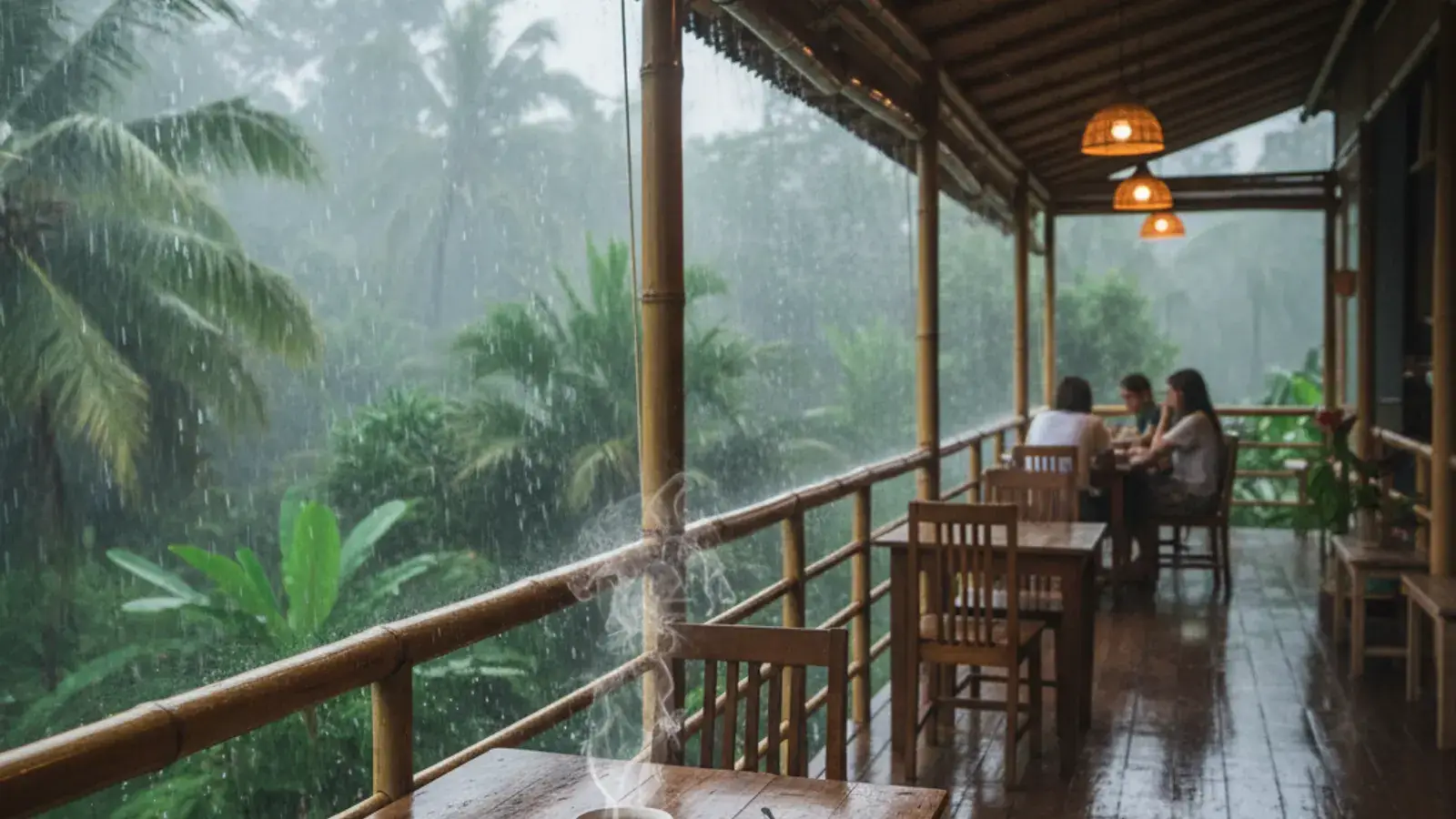
A rainy day in Ao Nang is rarely a washout. The monsoon runs May to October, but rain falls mostly in one or two intense bursts in the late afternoon — often lasting one to two hours — and mornings are usually dry even in September and October, the wettest months. When it does pour, you have real options: Thai massage from a few hundred baht an hour, half-day cooking classes, a proper cafe scene, and Krabi Town 30–40 minutes away by songthaew.
We live and work in Ao Nang year-round, and the row of little rain-cloud icons on your forecast app has remarkably little to do with the day outside. This guide covers what the rainy season actually looks like, why we think the green season is the most underrated stretch of the Krabi calendar, and exactly what to do when the sky opens — from massages and cooking classes to museum runs in Krabi Town and quiet corners to open a laptop.
In short:
- Rainy season is May–October; September and October are wettest, and November transitions into the dry peak.
- The typical pattern: dry-ish morning, one heavy shower late afternoon — do beaches and boats before noon.
- Hotels discount heavily May–October; the room fought over in January can cost a fraction of its peak rate.
- Wet-afternoon plan: massage (from a few hundred baht an hour), cooking class, cafe, or Krabi Town (30–40 minutes by songthaew).
- Book island tours one day ahead with a reschedule policy, and take the morning departure.
When is the rainy season in Ao Nang?
The southwest monsoon runs roughly May to October, with September and October the wettest months. November is a transition month — often still showery early on, then clearing into the dry, busy peak season from November to February. For the full year-round picture, see our month-by-month Krabi weather guide, plus the detailed guides to Krabi in September and Krabi in November.
Here is the part the rain-cloud icons never tell you: rain in Krabi is mostly convective. Heat builds through the day, clouds pile up over the limestone hills, and the rain falls in short, intense bursts — often in the late afternoon or evening, frequently lasting one to two hours. All-day grey drizzle of the northern-European kind is rare. Even in September and October, mornings are frequently dry and workable.
What that means for your itinerary:
| Period | What to expect | Your move |
|---|---|---|
| May–August | Plenty of sunny stretches; brief heavy showers, mostly late in the day | Beach mornings are usually safe |
| September–October | Wettest weeks; more frequent rain, rougher seas | Keep plans flexible; book boats a day ahead |
| November | Transitional — often showery early on, then clearing fast | Shoulder-season value before the crowds |
| November–February | Dry, calm peak season | Book rooms and tours ahead |
Whatever the month, front-load the outdoor stuff. Do the beach, the viewpoint, or the boat in the morning; save shopping, food, and spa time for the afternoon.
Is Ao Nang worth visiting in the green season?
Yes — green season is our favourite time in Ao Nang, and not just because it is quieter for us.
- Prices drop. Hotels along the strip and around Nopparat Thara discount heavily between May and October, and tour prices are easier to negotiate. The same room that is fought over in January can cost a fraction of its peak rate.
- The crowds thin out. Railay Beach without the shoulder-to-shoulder longtail queues is a different experience. You can walk Nopparat Thara at low tide and share it with a handful of people and the occasional monitor lizard.
- Everything turns green. The karst cliffs, usually framed by dry scrub late in high season, go vividly lush. Waterfalls and jungle pools in the province run full instead of trickling.
- The light is better. Post-rain skies give you the dramatic clouds and saturated colours that flat blue high-season skies never do. Photographers know this; most tourists do not.
The trade-off is simply uncertainty. You cannot guarantee a boat trip three days in advance. If you can travel with a loose schedule, the green season rewards you generously.
Planning around the rain? Start it at our table — we open at 8:00, five minutes from Nopparat Thara Beach. See the menu · Get directions
What to do in Ao Nang when it pours
Book the massage you kept postponing
A downpour is the best excuse you will ever get. Massage shops line the entire Ao Nang strip and the sois behind it, from simple fan-cooled shopfronts to full air-conditioned spas with steam and scrub packages. Street-side Thai massage typically starts at a few hundred baht an hour; proper spa packages run considerably more. Rainy afternoons are quiet, so you can usually walk in without a booking — and two hours of Thai massage plus the sound of rain on a tin roof is genuinely hard to beat.
Take a Thai cooking class
Several cooking schools around Ao Nang and Khlong Haeng run half-day classes year-round, most of them under cover, so rain changes nothing. You will typically visit a market, cook four or five dishes — think tom yum, green curry, pad thai, mango sticky rice — and eat everything you make. It is the single most useful souvenir you can take home, and classes book out less in green season, so you can often join at a day’s notice.
Go cafe-hopping
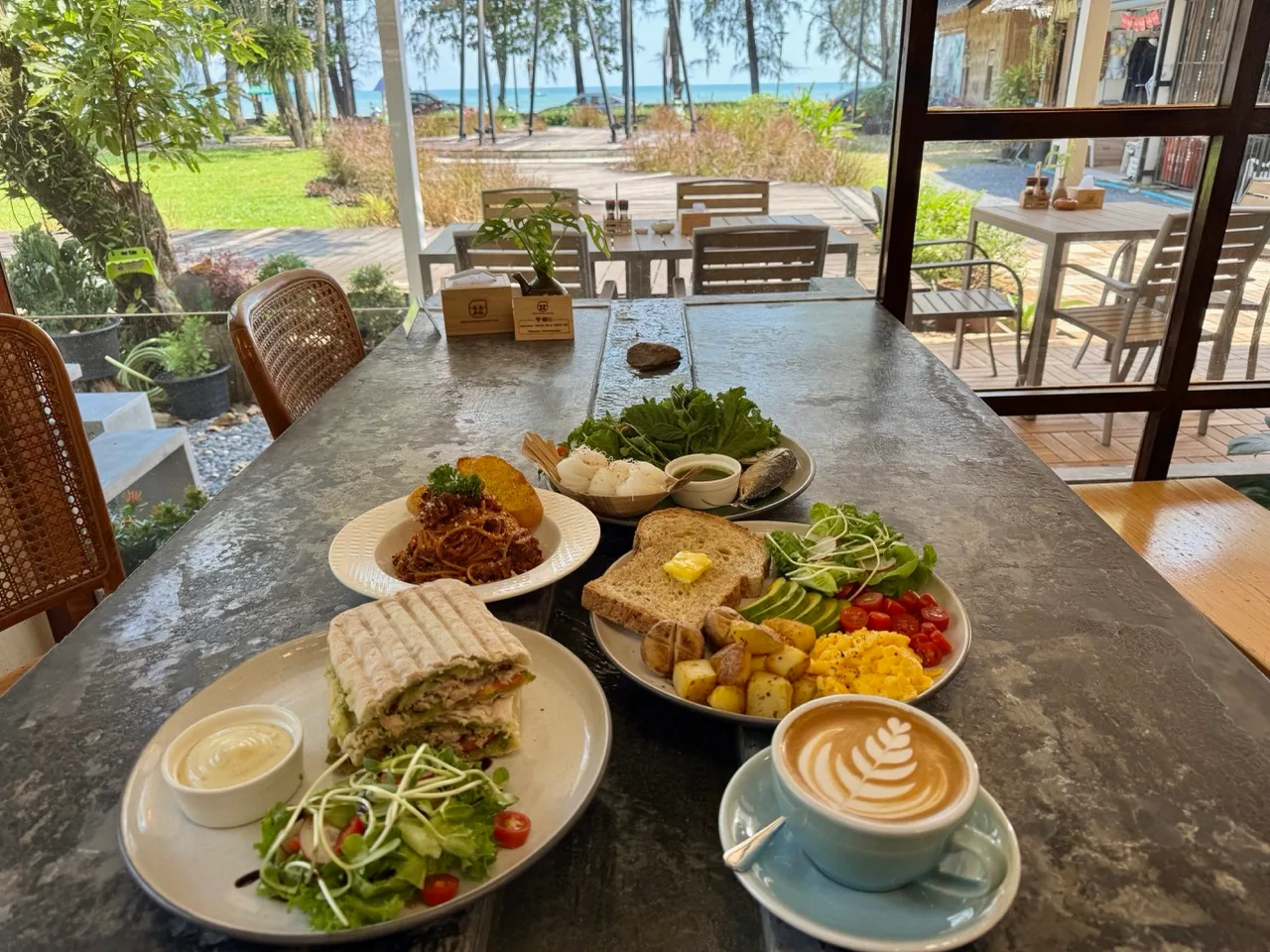
Ao Nang has developed a proper cafe scene, and a rainy afternoon is the time to explore it — specialty coffee, smoothie bowls, and bakeries are scattered along the beach road and up through Khlong Haeng. Our own place, Thongyib Thongyod Brunch & Cafe at Ao Nang Landmark (Sealay Village), is open daily 8:00–18:00, which conveniently covers both the clear mornings and the wet afternoons; if you are waiting out a storm, a Tom Yum coffee or yuzu coffee and a plate of golden thongyod desserts make the time pass quickly.
And if the rain has you pinned in your room, you no longer have to go anywhere: we deliver across Ao Nang on GrabFood daily 8:00–18:00, at the same prices as the cafe. A green-season afternoon, a pot of curry and a coffee arriving at your door is a perfectly respectable way to lose two hours.

Head into Krabi Town
Krabi Town is 30–40 minutes from Ao Nang by the white local songthaews that run all day, and it earns a half-day even in fine weather. On a wet one:
- Andaman Cultural Center near the riverfront has rotating exhibits on the region’s history and culture, and entry is free.
- Khao Khanab Nam viewpoint and the riverfront are worth a stroll between showers, with the town’s famous traffic-light sculptures along the way.
- The Krabi Weekend Night Market (walking street) runs Friday to Sunday evenings — dozens of food stalls, local crafts, and a live stage. Most of it is under awnings, and evening rain usually passes quickly.
- Catch a film. The Major Cineplex inside the big Lotus’s mall on the edge of town is Krabi’s cinema. Check listings first: English-language screenings exist but are hit-and-miss, and some foreign films are dubbed in Thai. The mall itself is a solid air-conditioned wander regardless.
Shop and graze at Ao Nang Landmark
You do not even need to leave Ao Nang. The Ao Nang Landmark complex in Khlong Haeng combines shops, restaurants, and a night market under and around covered walkways — an easy place to lose a wet evening grazing between stalls. Our own cafe sits inside the complex; we close at 18:00, so catch us for a late-afternoon coffee and Thai desserts, then stay on for the night-market stalls once they light up. It all sits about five minutes’ walk from Nopparat Thara Beach, so when the rain stops you can finish with a sunset walk on the sand.

Working remotely on rainy days: laptop-friendly Ao Nang
If you are working while you travel, green season Ao Nang is quietly excellent: accommodation is cheap, cafes are uncrowded, and the rain gives you guilt-free desk hours. A few honest tips from people who watch laptop workers every day:
- Work the wet afternoon, play the dry morning. Flip the usual nomad schedule on its head and it fits the weather here perfectly.
- Check the wifi before you commit. Most cafes in Ao Nang have decent connections, but speeds vary; run a quick test before a video call. Thai mobile data is cheap and fast, so a local SIM or eSIM as backup is worth it.
- Mind the peak lunch rush. In our cafe the calmest laptop hours are mid-morning and mid-afternoon, outside the lunch peak — we are happy to have you settle in with a long brunch and a refill during those windows. Wherever you work, ordering steadily rather than nursing one drink for four hours keeps everyone smiling.
- Storms occasionally knock power or internet out briefly. Keep your laptop charged and download what you need for offline work.
Do island tours still run in the rainy season?
Yes — the 4 Islands, Hong Islands, and Phi Phi trips all still run in green season. You just need to book them differently.
- Book one day ahead, not one week. Check the forecast the evening before and commit then. Agencies line the strip and same-day or next-day spots are easy to find outside peak season.
- Take the morning departure. Seas are usually calmer and skies clearer before the afternoon build-up.
- Choose refundable or reschedulable tours. Reputable operators will move you to the next day if the weather turns; confirm the policy before paying.
- Expect occasional cancellations in September–October. Longer crossings like Phi Phi are the first to be called off in rough seas; the closer 4 Islands trip is more resilient. Authorities also close some islands seasonally for recovery, so ask your operator what is open.
- Have a land day in your pocket. Tiger Cave Temple (1,260 steps to a spectacular summit view), the Emerald Pool area, or an elephant sanctuary visit all work in mixed weather.
Quick answers
Does it rain all day in Ao Nang during the rainy season? Rarely. Rain is convective — short, intense bursts, usually late afternoon or evening, often over within one to two hours.
How do you get from Ao Nang to Krabi Town? White local songthaews run all day and take 30–40 minutes. If you take a taxi instead, agree the price before boarding.
Are island tours cancelled in the rainy season? Occasionally in September–October, when rough seas call off longer crossings like Phi Phi first; the closer 4 Islands trip is more resilient. Book refundable tours one day ahead.
How much is a Thai massage in Ao Nang? Street-side Thai massage typically starts at a few hundred baht an hour; air-conditioned spa packages run considerably more.
Where should we wait out an afternoon downpour? At our place — Thongyib Thongyod, inside Ao Nang Landmark, is open 8:00–18:00 daily, and most showers pass in about the time it takes to finish a Tom Yum coffee and a plate of thongyod.
Practical information for rainy season Ao Nang
- Season: roughly May–October; September–October wettest; November transitional; November–February peak dry season.
- Typical pattern: clear-ish mornings, short heavy showers late afternoon or evening; all-day rain is uncommon outside the wettest weeks.
- Bring: a light rain jacket or poncho, dry bag for phones on boats, sandals that survive puddles. Umbrellas and ponchos are sold cheaply everywhere.
- Getting around: white songthaews link Ao Nang and Krabi Town all day; agree taxi prices before boarding.
- Mosquitoes: more active after rain — repellent at dusk is non-negotiable.
If a storm catches you at the Nopparat Thara end of town, come dry off with us — Thongyib Thongyod is at Ao Nang Landmark, open 8:00–18:00 daily, and rain on the roof pairs unreasonably well with mango sticky rice. Here is how to find us.