
Nopparat Thara Beach: Low Tide, Pier & Local Guide
By the Thongyib Thongyod team · Updated 24 August 2026
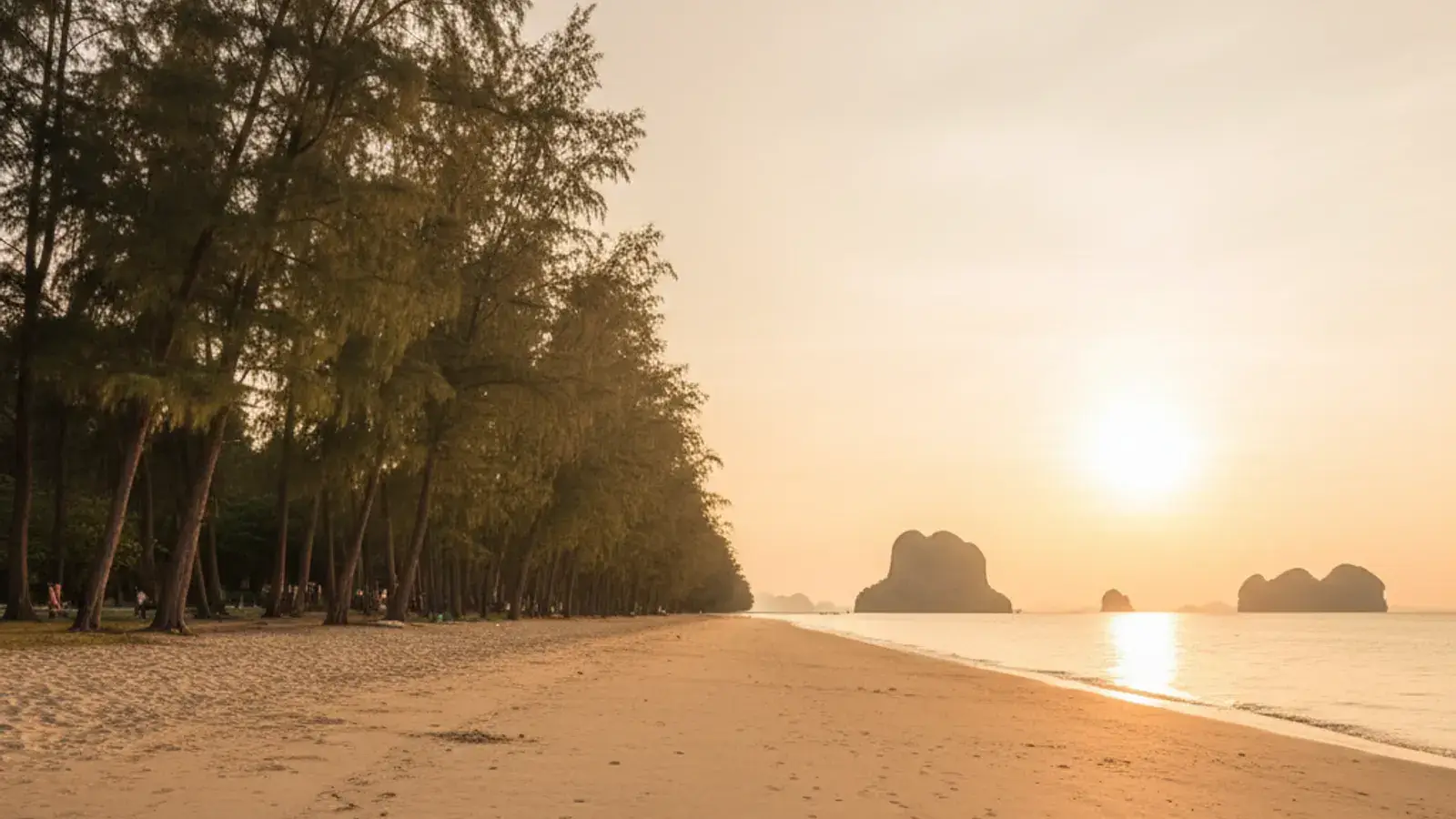
Nopparat Thara is the quiet beach that starts a 10–15 minute walk northwest of Ao Nang’s main strip: three kilometres of wide, casuarina-shaded sand where Thai families often outnumber tourists. It sits inside a national park, so there are no jet skis or beach clubs, roadside parking is free, and stalls just off the sand sell grilled chicken and som tam for 50–100 baht. Its best trick is the low tide, when the sea retreats hundreds of metres and a sandbar lets you walk out to the islets offshore.
In short:
- 10–15 minutes on foot northwest of Ao Nang’s main beach; the pier end is about 4 km from the centre.
- At a good low tide you can walk the exposed sandbar all the way to Koh Khao Pak Klong islet — check tide tables first.
- Part of Hat Noppharat Thara–Mu Ko Phi Phi National Park: real shade, no jet skis, free parking along the beach road.
- Beach-side stalls charge local prices (50–100 baht a dish); the seafood houses near the park end are the local dinner pick.
- Best plan: arrive around 16:30, walk the flats if the tide cooperates, stay for sunset. November–February has the clearest skies.
Our cafe sits about five minutes’ walk from the eastern end of the beach, so we cross it constantly — on morning runs, on errands to the pier, on lazy Sunday evenings when half of Khlong Haeng seems to be out on the sand. Over the years we have learned its rhythms: which hours the tide pulls back far enough to walk to the islets, where the local families set up their picnic mats, when the light turns the estuary gold. Here is everything we would tell a friend before their first visit.
How is Nopparat Thara different from Ao Nang’s main beach?
It trades the main beach’s road-and-restaurant backdrop for tree shade, space and a mostly local crowd. The first thing you notice is the trees. Where Ao Nang’s main beach is backed by a road and a row of restaurants, Nopparat Thara is lined with tall casuarinas — feathery, pine-like trees that throw real shade onto the sand for most of the day. Mixed in with coconut palms, they give the beach a completely different character: quieter, greener, and far more comfortable at midday when the main strip is baking.
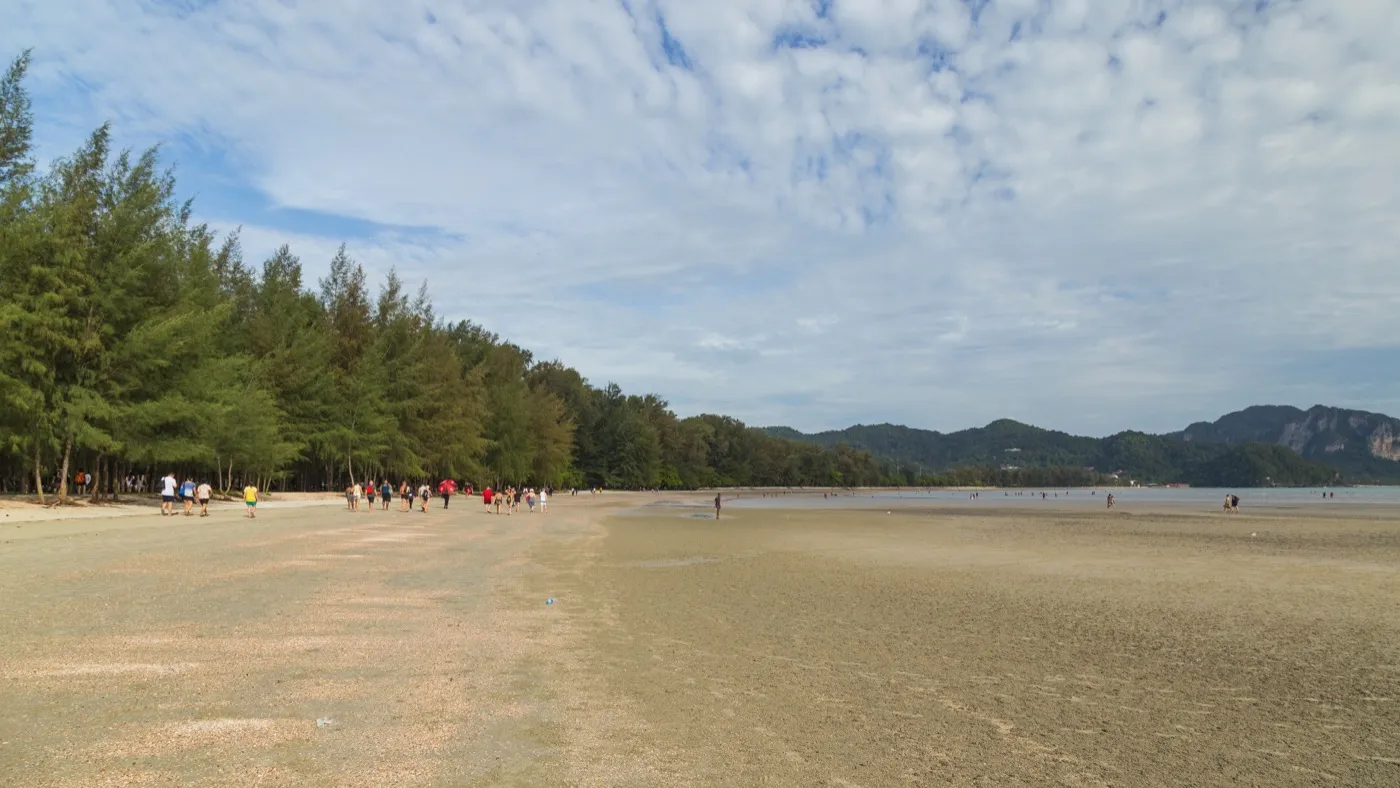
The second thing you notice is who is on the beach. Nopparat Thara is a favourite of local Thai families, especially on weekends and public holidays, when people from Krabi Town and the surrounding villages come with cool boxes, grilled chicken and sticky rice, and spread mats under the trees. Kids swim, grandparents doze, someone always has a speaker playing softly. It is one of the few beaches in the area where tourists are often outnumbered by locals, and the atmosphere is warmer for it.
Third: the beach is protected. Nopparat Thara forms part of Hat Noppharat Thara–Mu Ko Phi Phi National Park, and the park headquarters sits at the beach’s far western end, past the estuary. That end has a visitor centre, a large car park, a campsite and simple park bungalows — and, crucially, national park rules. Development is restrained, there are no beach clubs blasting music, and jet skis are absent. You will still find drink vendors and a few stalls near the car parks, but the overall feel is closer to a park than a resort.
One detail we like: the beach’s old name was Hat Khlong Haeng — “dried canal beach” — because at low tide the sea retreats so far that it leaves behind a wide, shell-strewn flat. Which brings us to the beach’s best trick.
Can you really walk to an island at low tide?
Yes — at the lowest tides a sandbar connects the beach to the islets just offshore, and you can stroll out with your feet barely getting wet. Twice a day the tide pulls back dramatically at Nopparat Thara, and at a good low it retreats hundreds of metres, exposing a huge expanse of firm, rippled sand dotted with shells and coral fragments. This is when the beach is at its most fun.
Start from the section of beach near the estuary and walk out across the flats towards the most prominent islet, Koh Khao Pak Klong — the jungle-topped rock you will have been staring at all afternoon. It feels slightly surreal the first time — walking out to an island on foot, the sea somewhere behind you.
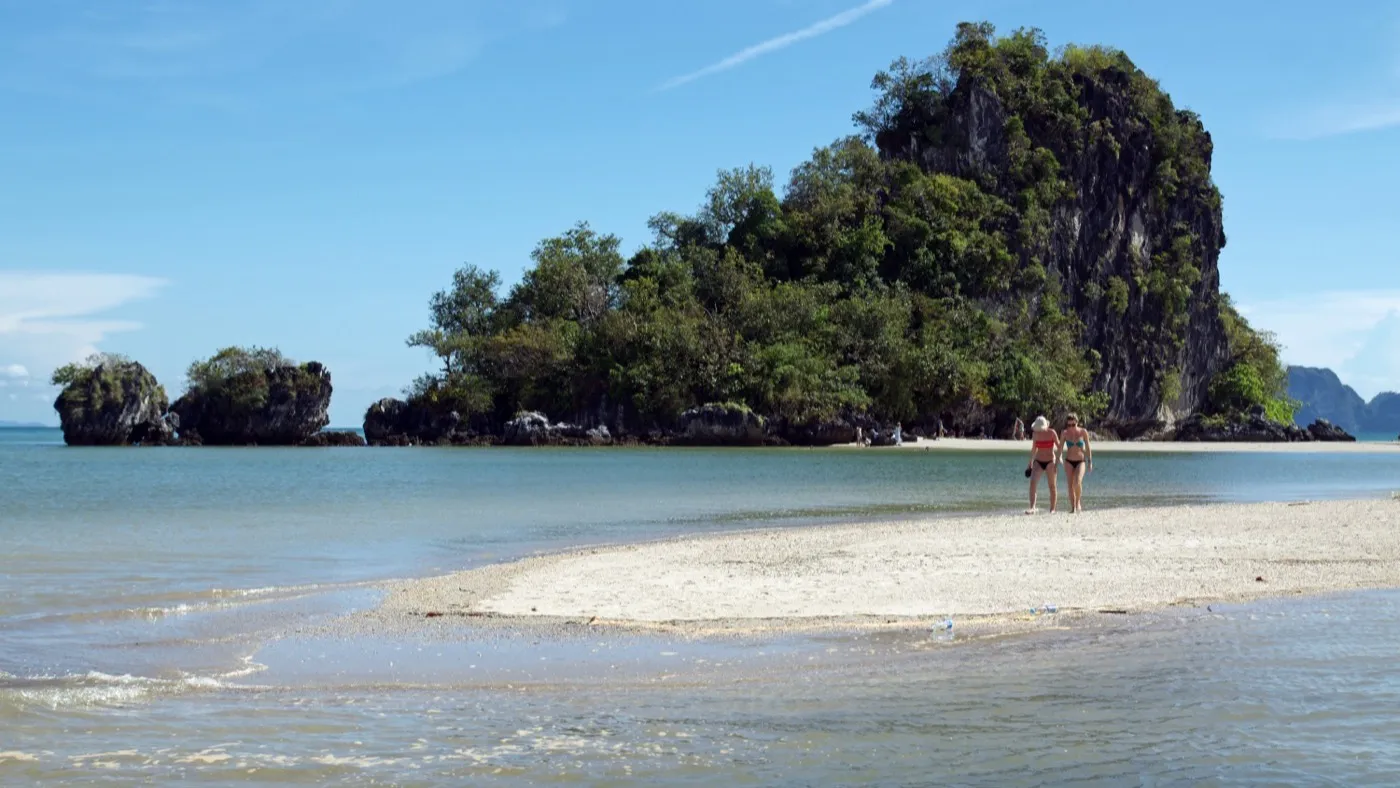
A few tips from many low-tide walks of our own:
- Check the tide times first. Any tide app or a quick search for Krabi tide tables will do. Aim to start your walk an hour or so before the lowest point, so you have time to explore and get back comfortably.
- Do not linger too long out there. The tide comes back in steadily, and what was ankle-deep can become waist-deep. Give yourself a generous margin.
- Wear sandals or reef shoes. The flats are scattered with shells and the occasional sharp coral fragment.
- Look down as you walk. The sand comes alive at low tide — sand bubbler crabs leave thousands of tiny rolled balls of sand in radiating patterns, hermit crabs trundle about, and small fish dart through the shallow pools.
Even if you skip the islets, the exposed flats are wonderful for a long barefoot walk, and children can spend hours in the warm, shallow pools left behind by the sea.
Planning a low-tide morning? Start it at our table — we open at 8:00, five minutes from Nopparat Thara Beach. See the menu · Get directions
Sunsets worth planning around
Nopparat Thara faces west-southwest across the Andaman Sea, which makes it one of the best sunset spots in the Ao Nang area. On a clear evening the sun drops behind the offshore islands, and the wet sand — especially at low tide — mirrors the whole sky in orange and pink.
The casuarina line means you can watch the show from the shade with a cold drink from one of the vendors, and because the beach is so long, it never feels crowded even when plenty of people have the same idea. In high season (November to February) the skies are most reliably clear; in the green season the clouds are heavier, but the sunsets, when they break through, are often the most dramatic of the year.
Our honest suggestion for a perfect Nopparat Thara evening: stop by Thongyib Thongyod on your way to the sand for an iced coffee and a box of Thai desserts to eat under the casuarinas — we close at 18:00, so collect before you settle in — then arrive around 16:30, walk the flats if the tide cooperates, and find a spot under the trees for the last hour of light. Dinner afterwards at one of the seafood houses near the park end, or at the Ao Nang Landmark night market on the walk home, rounds it off well.
Which boats leave from Nopparat Thara Pier?
Almost everything: if you are staying in Ao Nang, chances are your island trip departs from the pier at the western end of this beach. Here the Khlong Haeng canal meets the sea in a broad, mangrove-edged estuary, crossed near its mouth by a bridge to the national park side. It is a lovely, slightly wild corner — longtail boats moored in the channel, egrets picking through the mud at low water, fishermen heading in and out with the tide.
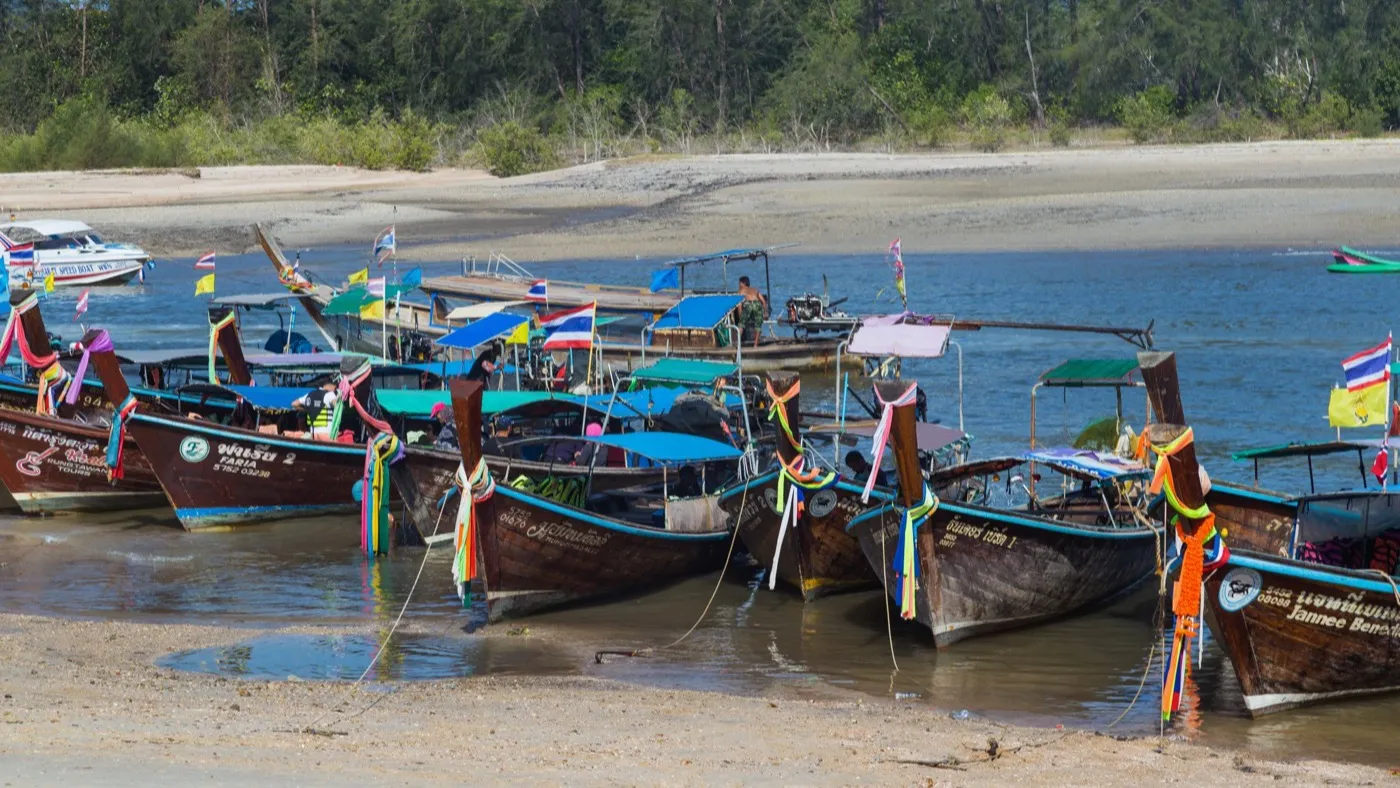
| Destination | Boat | Time |
|---|---|---|
| Railay Beach | Speedboat and ferry transfers daily (longtails also cross from the beach itself) | About 15 minutes |
| Phi Phi Islands | Ferry or speedboat | Roughly 1–2 hours depending on the boat |
| Koh Yao Noi, Koh Yao Yai, Phuket | Regular speedboat routes across Phang Nga Bay | Varies by route |
| 4 Islands, Hong Islands day tours | Tour boats board in the morning | Full or half day |
Even if you are not catching a boat, the pier area is worth a wander for the working-harbour atmosphere, and it is a good reminder that Nopparat Thara is not just a pretty beach — it is the gateway to almost everything offshore. Book island trips a day or two ahead in peak season — and if your pickup is mid-morning, there is time for a proper brunch at our place first, from 8:00 in Khlong Haeng.
Practical information
Getting there. From central Ao Nang, walk northwest along the beach road; the sand of Nopparat Thara begins just past the headland, about 10–15 minutes on foot from the main strip. Songthaews and taxis run along the beachfront road, and the pier end is about 4 km from central Ao Nang.
Parking. If you come by motorbike or car, there is free parking along the beach road for most of the beach’s length, plus a large national park car park at the western end near the headquarters (a small fee may apply there). Parking is far easier here than on the main strip.
Food and drink. Simple local eateries and street-food stalls sit just off the beach, selling grilled chicken, som tam, fried rice and fresh fruit at local prices — expect 50–100 baht for most dishes. Near the park headquarters end there are well-regarded seafood houses. Vendors along the beach sell drinks, ice cream and snacks. For breakfast before a beach day or an island boat, we are nearby: Thongyib Thongyod at Ao Nang Landmark in Khlong Haeng, about five minutes’ walk from the beach, open daily 8:00–18:00 with brunch on artisan sourdough and smoothie bowls that travel well to a picnic mat.
When to come.
- Season: November to February is peak season — dry, clear and busiest. May to October is the rainy season; the beach is much quieter, prices drop, and mornings are often still fine, but check the forecast and swim with care when seas are rough.
- Time of day: Mornings are calm and cool; late afternoon into sunset is the beach at its best. Weekends bring the local picnic crowds, which we consider a feature, not a drawback.
- Tides: For the sandbar walk, you need a low tide during daylight — check the tide table and plan around it.
Swimming. The water is shallow for a long way out, which makes it family-friendly at mid-to-high tide, but at low tide you will be walking a while before it is deep enough to swim.
Quick answers
How far is Nopparat Thara from Ao Nang? The sand begins about 10–15 minutes on foot past the headland at the end of Ao Nang’s beach road; the pier end is roughly 4 km from the centre, reachable by songthaew or taxi.
Is Nopparat Thara good for swimming? Yes at mid-to-high tide, when the shallow, calm water suits families well. At low tide the sea retreats so far that swimming means a long walk out.
When is the best time to visit? November to February for dry, clear weather, and late afternoon into sunset on any day. For the sandbar walk you need a low tide during daylight, so check a Krabi tide table.
Is there parking at the beach? Yes — free parking along the beach road for most of its length, plus a large national park car park at the western end where a small fee may apply.
Where should we eat before a morning at Nopparat Thara? At our place — Thongyib Thongyod at Ao Nang Landmark in Khlong Haeng, five minutes’ walk from the beach, open from 8:00. A smoothie bowl and a good coffee set up a low-tide walk nicely.
A beach worth slowing down for
Nopparat Thara rewards people who give it a full half-day rather than a quick look: a morning swim, lunch at a stall under the trees, the low-tide walk, then sunset from the sand. It is the Ao Nang we would show a friend on their first visit.
If your route to the beach passes through Khlong Haeng, come and say hello — we will send you off with a coffee in hand and, if you time it right, a box of mango sticky rice for the picnic.